England is a very different place. King Richard II sits on the throne. The Wars of the Roses are still decades away. There are no roads as we know them today, no cars, no electricity, no streetlights. Just fields, woodland, scattered villages and the sound of everyday life carried across the Essex countryside.
High Roding is a small farming community. Life follows the seasons. Harvests determine fortunes. News arrives slowly, carried by travellers rather than telephones.
And somehow… the year 1397 keeps finding its way back to The Lion.
We've seen it mentioned in local history articles, village memories and published accounts, all suggesting that the story of this remarkable place can be traced back to that year.
The frustrating part? We still don't know why. We've searched archives, records and historical references, but the original source continues to elude us.
Does 1397 mark the earliest mention of this site? Was there another building standing here before the one we see today? Or is there another story waiting patiently to be rediscovered?
For now, we simply don't know. But rather than ignore the mystery, we've chosen to embrace it. Because every great old building deserves at least one unanswered question.
A New Building Rises
Fast forward a little. Imagine standing in High Roding during the fifteenth century.
The village is alive with the sound of craftsmen at work. Great oak trees, felled from nearby woodland, are carefully shaped by hand. Every joint is measured with astonishing precision. Every beam is lifted into place using little more than ropes, timber frames and generations of experience.
There are no cranes. No power tools. No machinery. Just remarkable craftsmanship.
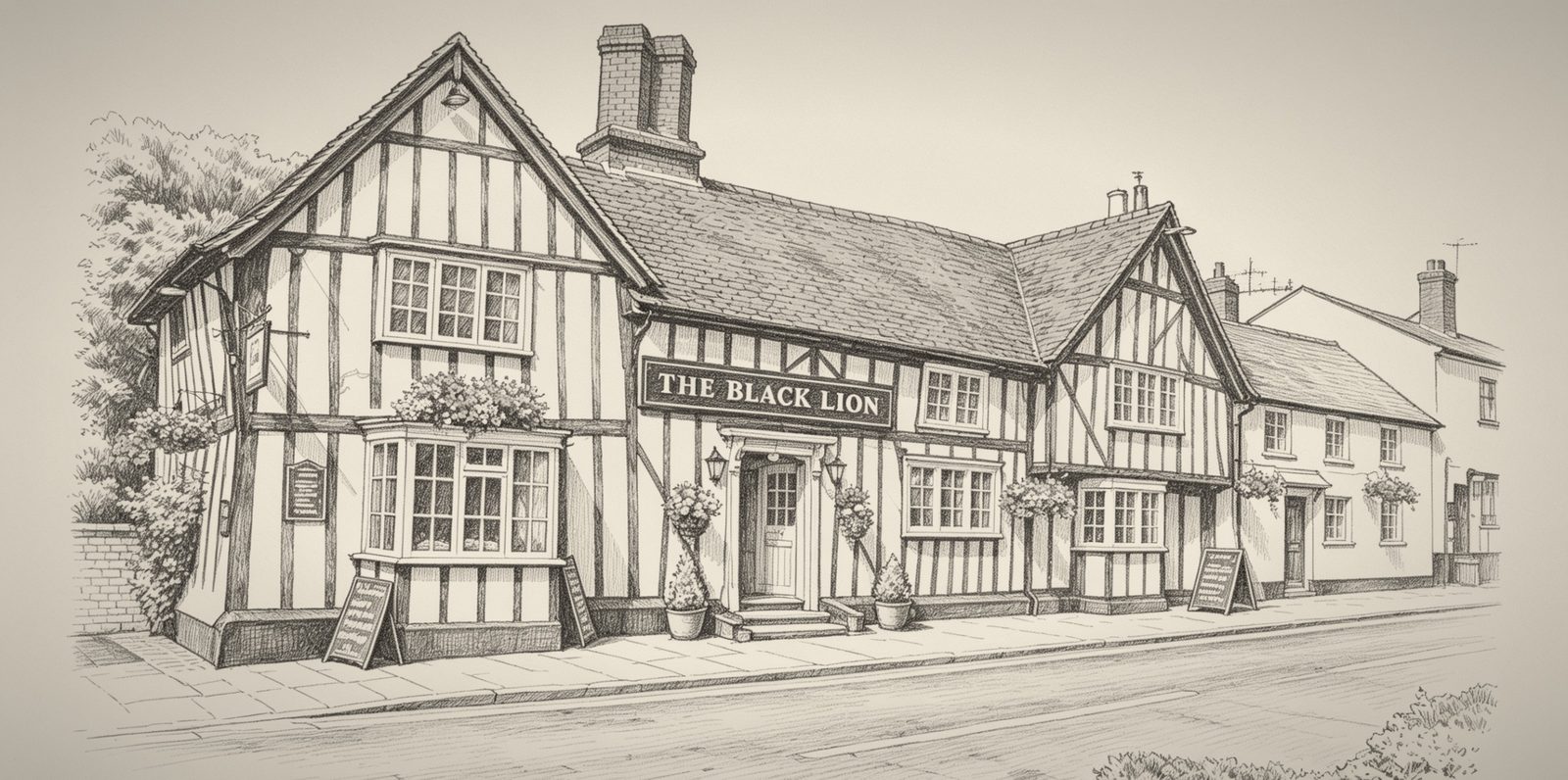
The building taking shape is a timber-framed hall house. More than six hundred years later, much of it still stands.
When you visit The Black Lion today, you're walking beneath beams that have watched century after century unfold. They've seen kings and queens come and go, wars begin and end, fashions change, technologies transform the world and generations of families make memories beneath the very same roof.
Old buildings have a quiet way of keeping secrets. Perhaps that's why we find them so fascinating.
Life Inside
Close your eyes for a moment and picture stepping through the doorway all those centuries ago.
The building feels very different from the one we know today. The great hall stretches upwards towards the roof, open to the timbers above. Smoke from a central fire drifts slowly through the building before escaping high overhead.
Light pours through small leaded windows. The scent of oak, wood smoke and freshly baked bread hangs in the air.
People gather around the warmth of the fire, sharing food, stories and news from neighbouring villages. Children play nearby. Dogs sleep beneath wooden benches. Outside, the seasons quietly continue their endless cycle.
We don't know the names of the people who lived here. History hasn't been that kind. But they were the first of countless generations who would leave their own small mark on this place.
Without ever knowing it… they were beginning the story of The Lion.
1543 · A Tudor Connection
Another century passes.
England is now in the Tudor period, and High Roding finds itself connected to one of the most famous families in English history.
At the time of her death in 1543, the manor of High Roding belonged to Mary Boleyn, sister of Anne Boleyn and aunt to Queen Elizabeth I.
Whether Mary herself ever passed through the village, we simply don't know.
Did she travel the roads that passed through High Roding? Did she look out across the same Essex countryside we see today?
Perhaps. Perhaps not. It's one of those wonderful questions that history leaves unanswered.
What we do know is that while England's royal court was full of politics, power and intrigue, life in High Roding continued much as it always had. Farmers worked the fields, neighbours relied on one another and this quiet corner of Essex carried on through another remarkable chapter in English history.
It's a lovely reminder that although The Lion's story belongs to High Roding, High Roding itself has played a small part in the much bigger story of England.
1642-1651 · Civil War & A Village Legend
The peace of village life was interrupted by one of the most turbulent periods in English history.
The English Civil War divided families, neighbours and communities across the country. Although we don't yet know exactly what happened here in High Roding during those years, it's difficult to imagine the village escaping untouched.
This period also gives us one of The Lion's oldest legends.
For generations, local people have spoken of a Roundhead officer whose ghost is said to haunt the old hayloft.
Is there any truth behind the story? We honestly don't know. No official records have confirmed it, and perhaps they never will.
But like so many old inns across Britain, The Lion has gathered its own folklore over the centuries, and this tale has become part of its character.
Whether you believe in ghosts or not, it's hard to stand beneath centuries-old oak beams without wondering just how many stories they could tell.
A Place That Endured
Centuries passed. The building changed with them. Rooms were altered. New spaces were added. The world beyond High Roding continued to evolve.
Yet through every generation, this remarkable old building remained. Waiting patiently for its next chapter.
And before long, that chapter would bring something that would define The Lion for centuries to come.
Travellers. Horses. The open road. And a warm welcome waiting at the end of the journey…
1642
Civil War & A Village Legend
The peace of village life was interrupted by one of the most turbulent periods in English history.
The English Civil War divided families, neighbours and communities across the country.
Although we don't yet know exactly what happened here in High Roding during those years, it's difficult to imagine the village escaping untouched.
This period also gives us one of The Lion's oldest legends.
For generations, local people have spoken of a Roundhead officer whose ghost is said to haunt the old hayloft.
Is there any truth behind the story? We honestly don't know. No official records have confirmed it, and perhaps they never will.
But like so many old inns across Britain, The Lion has gathered its own folklore over the centuries, and this tale has become part of its character.
Whether you believe in ghosts or not, it's hard to stand beneath centuries-old oak beams without wondering just how many stories they could tell.
Late 1600s - Early 1700s · A Place of Welcome
As the seventeenth century drew to a close, England was changing once again.
Roads improved, trade flourished and more people were travelling between towns and villages than ever before. The route through High Roding became an important link between London and Norwich, bringing a steady flow of travellers through the Essex countryside.
Somewhere during this period, we believe the old hall house became something more.
An inn.
Although we're still researching exactly when that transformation took place, it's easy to imagine what life here may have been like.
The sound of horses arriving outside after a long day's journey. A fire burning inside on a cold winter evening. Fresh food being prepared in the kitchen. Stories exchanged between people who, only hours before, had been complete strangers.
This wasn't simply somewhere to eat or drink. It was a place of rest. A place of warmth. A place where journeys paused before beginning again the following morning.
One local tradition tells us the pond outside The Lion was used to water coaching horses before they continued on their way. Another suggests the building stands on, or close to, the site of an even earlier Great Hall.
Whether these stories ultimately prove to be fact or folklore, they've become part of the character of The Lion, adding another layer to a history that's still revealing itself.
By the end of the eighteenth century, the picture finally becomes a little clearer.
For the first time in hundreds of years… we know the name of the person caring for The Lion.
1787 · The First Name We Know
For centuries, countless people must have lived and worked here. Sadly, history hasn't remembered all of them.
Then, after hundreds of years… a name finally appears.
Thomas Brett.
He's the earliest confirmed landlord we've identified so far, recorded at The Lion in 1787.
By now, the building was already an old one. Generations had come and gone beneath its beams. Imagine everything it had already witnessed before Thomas first walked through its doors. Children growing up within its walls. Harvest celebrations. Storms. Hard winters. Days of laughter. Days of sorrow.
The building quietly endured it all.
Although very little is known about Thomas himself, we're proud that his name once again has a place in The Lion's story.
1870 · Another Chapter
Almost a century later, another name appears.
William Bartrop.
Like Thomas Brett before him, William became another custodian of a building that was already rich in history.
We know only fragments about his time here, but every fragment matters. Each discovery helps us rebuild another chapter that might otherwise have been forgotten.
1891 · A Face From The Past
By the closing years of the nineteenth century, another familiar name appears in the historical record.
John Ridgwell.
For us, John represents something rather special.
During our research, one of his descendants got in touch from Wales after discovering their family's connection to The Lion. Alongside their message came something extraordinary. A photograph.
For the first time, one of the names we'd discovered in old directories suddenly became a real person. A face. A family. A life connected to this building more than a century ago.
It's moments like these that remind us why preserving history matters. Every name we uncover belonged to someone who once called The Lion home. And perhaps there are many more still waiting to be rediscovered.
As the nineteenth century drew to a close, the world was changing faster than ever before.
The twentieth century would bring motor cars, electricity, two world wars and another unforgettable chapter in The Lion's history. The Ridley's years were about to begin.
1924
A New Chapter Begins
By the beginning of the twentieth century, The Lion had already stood in High Roding for centuries. Generations had walked through its doors, and the names of Thomas Brett, William Bartrop and John Ridgwell had each found their place in its story.
Now, another chapter was about to begin.
In 1924, The Black Lion became part of the Ridley's Brewery estate, marking the start of a relationship that would last for more than eighty years. While the ownership had changed, the role of the pub remained exactly the same. It was still the place where neighbours met, travellers stopped and village life unfolded one conversation at a time.
As the years passed, one custodian handed the keys to the next, each becoming part of a story that had already been centuries in the making.
1930s - 1950s · The Lion Finds Its Rhythm
As Britain changed, so did village life. Cars gradually replaced horse-drawn traffic, electricity became part of everyday life and the world beyond High Roding seemed to move a little faster with each passing year.
Inside The Lion, however, some things never really changed.
There was always someone to chat to. There was always news to catch up on. There was always a warm welcome waiting inside.
It became part of the rhythm of village life, not just somewhere to enjoy a drink, but somewhere people naturally came together.
1950s - 1970s · The Simpson Family
As we've spoken to villagers and researched The Lion's history, one family has been mentioned more than almost any other.
The Simpsons.
Bernie and Gladys Simpson are remembered with enormous affection by those who knew them. Their family were also connected with the general store and filling station in nearby Leaden Roding, making them familiar faces across the local community.
Their son, John Simpson, travelled each day to King Edward VI Grammar School in Chelmsford, while relatives have shared happy memories of family Christmases spent at The Lion.
Other villagers remember wedding receptions in the Tea Rooms, celebrations that brought families together and a pub that always seemed to sit at the heart of village life.
Although we're still researching exactly when the Simpson family became custodians of The Lion, their place in its story is beyond doubt.
Life Beyond The Bar
Some of our favourite discoveries haven't come from official records. They've come from memories.
We've heard about the orchard that once stood at the top of the gardens. The ducks that paddled on the pond. A beautiful rose garden near the road. The Tea Rooms, where wedding receptions and family celebrations created memories that are still talked about today.
These moments may never appear in trade directories or brewery records, but they're every bit as much a part of The Lion's history.
After all, a pub isn't remembered because of its walls. It's remembered because of the people who filled them.
1980s - 1990s · The Ricci Years
As another generation took on the care of The Lion, new memories began to take shape.
Many local people still speak warmly of Ossie and Chiara Ricci. Time and again we've heard the same stories. Beautifully kept Ridley's ales. Hearty, home-cooked food. Christmas lunches that became family traditions.
One person still remembers the finest steak they'd ever eaten here. Several others immediately mention Ossie's lasagne, insisting it was simply the best.
There was a thriving darts team. A Ridley's quiz league team. Friends met after work, neighbours called in for "just one" and visitors quickly became regulars.
For many, this is the chapter of The Lion's story they remember most vividly.
2005 · Another Change Behind The Scenes
After more than eighty years, the Ridley's chapter came to an end when the brewery became part of Greene King.
Although ownership changed, The Lion continued to do what it had always done. It welcomed people.
As one generation passed on the responsibility of caring for the pub, another quietly took its place.
2010 - 2014 · New Custodians
Historical records show Maria Jane Hockley operating The Black Lion during the early 2010s. Although we're still researching this period of the pub's history, Maria became another custodian of a building that had already stood for well over five centuries.
In 2014, The Black Lion became part of Hawthorn Leisure following Greene King's sale of a number of former Ridley's pubs. For those walking through the front door, very little changed. The old beams still watched over the bar. The fires still burned through the winter. The conversations carried on.
2016 · A Proper Landlord
By the time John Sanders became the custodian of The Black Lion, the pub had already stood at the heart of High Roding for centuries.
Like every landlord before him, he inherited far more than a set of keys.
He inherited a place that mattered to people.
As we've spoken to villagers and read the many messages shared following John's passing, one phrase appears again and again.
“A proper landlord.”
It's difficult to think of a finer compliment.
People remember John not just for keeping a good pint or creating a welcoming pub, but for the way he treated people.
He always had time for a chat. He was generous with his time. He was kind, honest and quietly looked after those around him.
Several people shared stories of John dropping whatever he was doing to help a neighbour in need, while others simply remembered that everyone who walked through the door was made to feel welcome.
Again and again, another part of John's story appears.
The dogs.
For many visitors, The Black Lion simply wouldn't have been the same without them. They became part of the pub's character, greeting regulars, welcoming newcomers and reminding everyone that this was, above all else, a home as well as a village pub.
Many people remember enjoying lunch with a dog resting happily by their side, while others smile at the memory of each new member of John's ever-growing pack.
John was also known for his well-kept real ales, his love of bringing people together and the warm, relaxed atmosphere he created. Whether people came for a quiet pint, live sport, an evening with friends or simply a chat, they knew they would be welcomed.
We were fortunate enough to know John ourselves, which makes reading these memories all the more special. Although every person's experience was different, the themes are remarkably consistent. Time and again, people describe the same qualities: kindness, generosity, a warm welcome and someone who genuinely cared about both his pub and his village.
Perhaps that's the greatest legacy any landlord could leave.
Not simply a successful pub, but a community that remembers you with such affection.
John became an important part of The Black Lion's long story, and we're proud that his chapter will always have its place within these pages.
In 2021, Hawthorn Leisure became part of Admiral Taverns, beginning the latest chapter in the ownership of The Black Lion.
Although companies may change and decades may pass, one thing has remained remarkably constant. For more than six centuries, this building has continued to welcome people through its doors.
And somewhere inside its old beams, we like to think every generation has left behind a little of its own story.
Beyond the Records
Where History Meets Folklore
By this point in our journey, we've reached the end of the history we can confidently piece together through records, trade directories, family research and official documents.
But every old pub has another side to its story. The stories that can't always be found in an archive. The ones passed from grandparents to grandchildren. The tales shared over a pint. The little mysteries that somehow become part of a building's character.
Some may one day be proven true. Others may remain exactly as they are, wonderful pieces of local folklore. Either way, they deserve to be remembered.
The Mystery of 1397
It all began with a single year. 1397.
The date appeared again and again during our research. We found it mentioned in local history articles, conversations with villagers and published accounts, each suggesting that The Lion's story can be traced back to this remarkable year.
Naturally, we wanted to know why. So we started digging.
We've searched historic records, explored archives and followed every lead we could find, but at the time of writing, the original source remains a mystery.
Perhaps 1397 marks the earliest written reference to the site. Perhaps it relates to an earlier building. Or perhaps the answer is still waiting to be discovered in an old ledger, a forgotten document or a family collection that hasn't seen the light of day for generations.
Until we know for certain, we'd rather ask the question than pretend to know the answer. Sometimes, a mystery is worth preserving.
A Great Hall Beneath Our Feet?
One story we've heard more than once is that The Lion stands on, or very close to, the site of an earlier Great Hall. Some even suggest that timbers from that building were reused when the medieval hall house was constructed.
At the moment, we can't confirm that story. But neither can we dismiss it. Old buildings often reveal their secrets slowly. Perhaps one day this one will too.
The Coaching Pond
Stand outside The Lion today and it's easy to picture horses stopping nearby after a long journey.
Local tradition says the pond outside the pub was once used to water coaching horses travelling between London and Norwich.
We've yet to find the evidence that proves it. But we hope we do. Until then, it's another story that has earned its place in The Lion's history.
The Gold Hidden in the Wall
One of our favourite stories tells of gold coins discovered during alterations between the former Public Bar and Lounge Bar.
Unfortunately, that's almost where the trail ends. When were they found? How old were they? Where did they go? We don't know.
If you do, we'd love to hear from you.
The Ghost in the Hayloft
No old village pub would be complete without a ghost story.
For generations, people have spoken of a Roundhead officer said to haunt the old hayloft.
Is it true? We couldn't possibly say. But if these old beams really could talk, we're sure they'd have a tale or two to tell.
Across the Atlantic
One of the most unexpected stories we've uncovered began thousands of miles away.
An American researching their family history discovered that one of their ancestors was believed to have kept The Lion on behalf of a wealthy landowner while also caring for coaching horses.
The family believed they could trace their ancestry back to one of the Pilgrim Fathers who sailed to America in 1620.
It's a remarkable story, and one we're continuing to investigate. Perhaps one day we'll uncover the original letter that first connected High Roding with the other side of the Atlantic.
Famous Visitors
Among the memories shared with us is the suggestion that Steve Marriott of Small Faces and Humble Pie was once a regular visitor to The Lion.
At the time of writing, we're still searching for evidence to confirm the story. Whether it proves to be fact or simply another well-loved village tale, it's become another fascinating thread in the rich tapestry of The Lion's history.
If you've made it this far, thank you for taking the journey with us.
When we first began researching The Lion, we thought we'd be putting together a simple timeline. A few dates. A handful of names. Perhaps an old photograph or two.
Instead, we discovered something far greater.
We discovered that The Lion's history doesn't belong to one person, one family or one generation. It belongs to everyone who has ever walked through its doors.
Every landlord and landlady. Every member of staff. Every regular who had "their" seat at the bar. Every couple who celebrated a wedding. Every child who ran through the gardens. Every darts player. Every quiz team. Every traveller who stopped here on their journey.
Every story has become another thread in the fabric of this remarkable old building.
Some have been carefully preserved in official records. Others survive only because somebody remembered them. Both are equally important.
As you've seen throughout this page, there are still gaps in the story. We're still searching for the truth behind 1397. We're still trying to complete the list of every custodian who has cared for The Lion. We're still uncovering photographs, memories and newspaper articles that help us better understand the life of this wonderful old pub.
Perhaps that's exactly how it should be. History is never truly finished. It's always waiting for the next discovery.
Can You Help?
Do you have an old photograph of The Lion? Perhaps a wedding picture taken in the Tea Rooms. A family celebration. A darts team photograph. An old menu. A newspaper clipping. A story told by a parent or grandparent.
Maybe you worked here. Maybe someone in your family did. Maybe you simply remember what it felt like to walk through the door.
If you have anything you'd be happy to share, we'd be incredibly grateful to hear from you. Every contribution, no matter how small, helps us preserve another piece of The Lion's story for future generations.
Share Your Story
Thank You
Finally, thank you to everyone who has already helped us. To those who've searched through family albums. To those who've shared photographs and memories. To those who've corrected dates, answered questions and pointed us towards new discoveries.
This page exists because of your generosity. We hope you've enjoyed reading it as much as we've enjoyed bringing it together.
And if you happen to uncover another story tomorrow… we'll be ready to add another page.
After all… the best village pubs are never really finished. Neither are their stories.